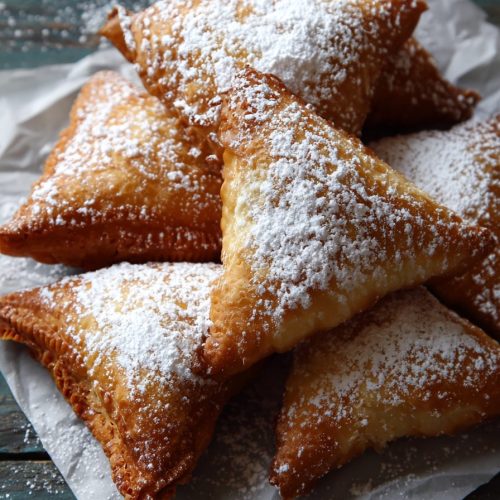
Lawrence Bakery New Orleans Beignets-Style Sweet Dough
Pillowy, New Orleans–style beignets made from a soft sweet dough enriched with eggs and butter, fried until golden and dusted generously with powdered sugar. Perfect for bringing classic French Quarter bakery vibes into your own kitchen.
Ingredients
- 3 1/2 cups all-purpose flour about 420 g, plus more for dusting; use unbleached if possible
- 2 1/4 teaspoons active dry yeast one 7 g packet; instant yeast can be used, skip proofing step
- 1/2 cup whole milk warm, about 105–110°F (120 ml)
- 1/4 cup water warm, about 105–110°F (60 ml)
- 1/4 cup granulated sugar divided; 1 teaspoon used for proofing yeast
- 2 large eggs room temperature
- 4 tablespoons unsalted butter melted and slightly cooled (56 g)
- 1 teaspoon fine sea salt
- 1 teaspoon pure vanilla extract
- vegetable oil or canola oil for frying, about 6–8 cups depending on pot size; use neutral oil with high smoke point
- 1 1/2–2 cups powdered sugar for dusting; sift if clumpy
- pinch ground cinnamon optional; mix into powdered sugar for a twist
Instructions
- In a small bowl, stir together the warm water, 1 teaspoon of the granulated sugar (taken from the 1/4 cup), and the active dry yeast. Let it stand for 5–10 minutes, until the mixture is foamy and creamy on top. If it does not foam, discard and start again with fresh yeast and correctly warmed liquids.2 1/4 teaspoons active dry yeast, 1/4 cup water, 1/4 cup granulated sugar
- In a large mixing bowl or the bowl of a stand mixer, whisk together the warm milk, remaining granulated sugar, eggs, melted and slightly cooled butter, vanilla, and salt until well combined. The mixture should be pale yellow and the sugar mostly dissolved.1/2 cup whole milk, 1/4 cup granulated sugar, 2 large eggs, 4 tablespoons unsalted butter, 1 teaspoon pure vanilla extract, 1 teaspoon fine sea salt
- Add the foamy yeast mixture to the bowl with the wet ingredients and stir to combine. Add 2 cups of the flour and mix with a wooden spoon or the paddle attachment on low speed until smooth. Gradually add the remaining 1 1/2 cups flour, about 1/2 cup at a time, mixing until a soft dough forms that is slightly sticky but pulls away from the sides of the bowl. If extremely sticky, add 1–2 tablespoons more flour, but avoid adding too much to keep the dough tender.3 1/2 cups all-purpose flour, 2 1/4 teaspoons active dry yeast
- Turn the dough out onto a lightly floured surface or switch to a dough hook on your stand mixer. Knead by hand for 6–8 minutes, or with the mixer on medium-low for 5–6 minutes, until the dough is smooth, stretchy, and elastic. It should feel soft and a bit tacky but not gluey, and should slowly bounce back when pressed.3 1/2 cups all-purpose flour
- Lightly oil a clean bowl and place the dough inside, turning once to coat it in a thin layer of oil. Cover the bowl with plastic wrap or a clean kitchen towel and let the dough rise in a warm, draft-free spot for 1 to 1 1/2 hours, or until about doubled in size. If your kitchen is cool, you can place the bowl in a turned-off oven with the light on.
- Gently punch down the risen dough to release excess gas. Turn it out onto a lightly floured surface and roll it into a rectangle about 1/4 inch thick. Using a pizza cutter or sharp knife, cut the dough into 2–2 1/2 inch squares. They do not need to be perfectly even.
- Transfer the dough squares to a lightly floured baking sheet or parchment-lined tray, leaving a little space between them. Cover loosely with a kitchen towel and let rest for 20–30 minutes, until slightly puffy.
- In a heavy-bottomed pot or Dutch oven, pour in 2–3 inches of vegetable or canola oil. Heat the oil to 360–370°F, using a deep-fry thermometer if possible. Without a thermometer, test by dropping in a small scrap of dough: it should sizzle immediately, float in about 5 seconds, and turn golden in about 45–60 seconds. If it browns in about 10 seconds, the oil is too hot.vegetable oil or canola oil
- Working in batches, carefully place 3–5 dough squares into the hot oil at a time, avoiding overcrowding. Fry for 1–2 minutes per side, turning once, until puffed and deep golden brown. Use a slotted spoon to transfer the fried beignets to a paper towel–lined plate or cooling rack to drain. If they are dark but flat, reduce the oil temperature slightly.
- While the beignets are still warm, place powdered sugar in a fine-mesh sieve (optionally mixed with a pinch of cinnamon) and generously dust the tops and sides until well coated. Serve immediately with extra powdered sugar on the side. Beignets are best within 15–20 minutes of frying.1 1/2–2 cups powdered sugar, pinch ground cinnamon
Notes
Yield: about 20–24 medium beignets. For overnight beignets, refrigerate the dough after kneading for up to 24 hours, then let sit at room temperature 45–60 minutes before shaping. To freeze, cut dough into squares, freeze on a tray, then store in a freezer bag for up to 1 month; thaw overnight in the fridge and let rise until puffy before frying. For variations, you can add 1 tablespoon espresso powder to the dough for café au lait beignets, toss hot beignets in cinnamon sugar before dusting, pipe in jam or pastry cream for filled beignets, add 1 teaspoon citrus zest to the dough, or glaze instead of dusting with powdered sugar. Beignets are best served immediately; leftovers keep in an airtight container at room temperature up to 1 day and can be reheated in a 300°F oven for 5–8 minutes, then dusted again with powdered sugar.
Nutrition
Calories: 220kcal
Love this recipe?Follow us at @Recipecs for more