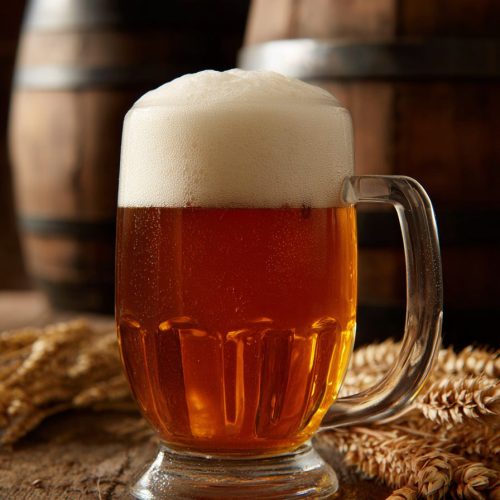
Einbecker Mai Urbock Homebrew (Golden German Maibock for Spring)
A strong, golden German Maibock (Mai Bock) style lager inspired by Einbecker Mai Urbock: rich, bready malt, elegant noble hops, and a clean, dry finish. Designed as a 5-gallon all-grain homebrew with an optional extract version.
Ingredients
- 10.5 lb German Pilsner malt high-quality, such as Weyermann or Bestmalz
- 2 lb Munich malt 8–10L
- 0.75 lb Vienna malt
- 0.5 lb CaraHell or light caramel malt 8–10L
- 0.25 lb Melanoidin malt optional but recommended; use lightly
- 1.25 oz Hallertau Mittelfrüh hops 4% AA, 60 minute addition
- 0.5 oz Hallertau Mittelfrüh hops 30 minute addition
- 0.5 oz Tettnang or Spalt hops 10 minute addition; Hallertau can be substituted
- 1 tablet Whirlfloc or 1 tsp Irish moss, at 10–15 minutes left in boil
- Yeast nutrient per manufacturer’s instructions, at 10–15 minutes left in boil
- Lager yeast Wyeast 2206 Bavarian Lager, WLP833 German Bock Lager, or Lallemand Diamond Lager (use ~250–300 billion cells; 2 rehydrated packs if dry)
- Brewing water aim for Ca 40–60 ppm, Cl 50–70 ppm, SO4 30–40 ppm; start with RO/distilled if needed and treat chlorine/chloramine
- Sanitizer for all post-boil equipment
- 6.6 lb Light or Pilsner liquid malt extract (LME) for extract version (optional)
- 1.5 lb Munich LME or DME for extract version (optional)
- 0.5 lb CaraHell steeping grains for extract version (optional)
- 0.25 lb Vienna malt steeping grains for extract version (optional)
Instructions
- Heat 3.75–4 gallons (14–15 L) of water to about 162°F (72°C). Add the crushed all-grain bill (German Pilsner, Munich, Vienna, CaraHell/light caramel, and optional Melanoidin malt) while stirring to avoid clumps, targeting a mash temperature of 150–152°F (65–67°C). Hold this temperature for 60 minutes, stirring gently once around the 30-minute mark.10.5 lb German Pilsner malt, 2 lb Munich malt, 0.75 lb Vienna malt, 0.5 lb CaraHell or light caramel malt, 0.25 lb Melanoidin malt, Brewing water
- Raise the mash temperature to 168°F (76°C) and hold for about 10 minutes for mash out. Vorlauf (recirculate) until the wort runs relatively clear, then sparge with 168°F (76°C) water until you collect about 6.5–6.75 gallons (25–26 L) of wort in the kettle, depending on your system’s boil-off rate.Brewing water
- Bring the wort to a strong rolling boil and boil for 60 minutes. At 60 minutes remaining, add 1.25 oz Hallertau Mittelfrüh hops for bittering. At 30 minutes remaining, add 0.5 oz Hallertau Mittelfrüh for flavor. At 15 minutes remaining, add Whirlfloc (or Irish moss) and yeast nutrient. At 10 minutes remaining, add 0.5 oz Tettnang or Spalt hops (or substitute Hallertau) for aroma. Watch for boil-overs, especially early in the boil.1.25 oz Hallertau Mittelfrüh hops, 0.5 oz Hallertau Mittelfrüh hops, 0.5 oz Tettnang or Spalt hops, 1 tablet Whirlfloc, Yeast nutrient
- At the end of the 60-minute boil, turn off the heat and chill the wort as quickly as possible using your chiller. Aim to reduce the temperature to 46–48°F (8–9°C); slightly warmer is acceptable, but cooler pitching helps reduce off-flavors. Try to get the wort below 70°F (21°C) within 20–30 minutes.
- Transfer the cooled wort to a thoroughly sanitized fermenter, targeting a post-boil volume of about 5.25 gallons (20 L). Aerate the wort well by shaking vigorously for 2–3 minutes or using pure oxygen through a diffusion stone for about 60 seconds.Brewing water, Sanitizer
- Pitch a large, healthy dose of lager yeast (approximately 250–300 billion cells; for dry yeast, use 2 properly rehydrated packs). Pitch at 46–50°F (8–10°C) and set your fermentation chamber or temperature control to maintain 48–50°F (9–10°C).Lager yeast
- Allow the beer to ferment at 48–52°F (9–11°C) for about 10–14 days. Visible activity should begin within 24–48 hours. When the krausen starts to fall and the gravity is within 4–6 points of your expected final gravity (around 1.012–1.014), prepare for the diacetyl rest.
- Gradually raise the fermentation temperature to 60–62°F (15–16°C) over 1–2 days and hold at that temperature for 2–3 days. This diacetyl rest allows the yeast to clean up buttery and other fermentation byproducts, resulting in a cleaner-tasting Maibock.
- After the diacetyl rest, cool the beer down slowly by 2–4°F (1–2°C) per day until you reach 32–36°F (0–2°C). Lager at this temperature for 4–8 weeks. The extended cold conditioning will smooth the malt character, refine the finish, and improve clarity.
- For kegging, transfer the finished beer to a sanitized keg, minimizing oxygen exposure, and force carbonate to 2.4–2.6 volumes of CO₂. For bottling, add priming sugar calculated for about 2.4–2.5 volumes of CO₂, bottle, and condition at 65–70°F (18–21°C) for 2–3 weeks, then chill before serving.Sanitizer
- Serve the Einbecker-style Maibock cold but not icy, at about 42–46°F (6–8°C), in a tall lager glass, Willi becher, or stemmed tulip to showcase its deep golden color, malt aroma, and elegant noble hop character.
- For the extract version, steep 0.5 lb (0.23 kg) CaraHell and 0.25 lb (0.11 kg) Vienna malt in 150–155°F (65–68°C) water for 30 minutes, then remove the grains. Take the kettle off heat and add 6.6 lb (3 kg) light or Pilsner LME and 1.5 lb (0.68 kg) Munich LME or DME, stirring to dissolve. Return to heat, bring to a boil, and follow the same hop schedule, boil time, chilling, fermentation, and lagering steps as in the all-grain version.6.6 lb Light or Pilsner liquid malt extract (LME), 1.5 lb Munich LME or DME, 0.5 lb CaraHell, 0.25 lb Vienna malt, 1.25 oz Hallertau Mittelfrüh hops, 0.5 oz Hallertau Mittelfrüh hops, 0.5 oz Tettnang or Spalt hops, 1 tablet Whirlfloc, Yeast nutrient, Lager yeast
Notes
Targets (approx.): OG 1.066–1.070, FG 1.012–1.014, ABV 6.8–7.2%, IBUs 32–36, SRM 6–8 (deep gold). Mash lower (150–152°F) for a drier, more drinkable Maibock; higher mash temps can leave the beer too full and sweet. For more traditional character, a 90-minute boil can help drive off DMS when using a high proportion of Pilsner malt. Yeast health and adequate oxygenation are critical for a clean, fusel-free strong lager. Variations: increase Pilsner malt by 1–1.5 lb for a stronger “Urbock+,” add small amounts of darker malts for a deeper color, or adjust late hops (e.g., Perle or Saphir) for a spicier or citrus-floral note. Best consumed within 3–4 months of packaging, though it can remain good up to 6 months if kept cold and protected from light.
Love this recipe?Follow us at @Recipecs for more