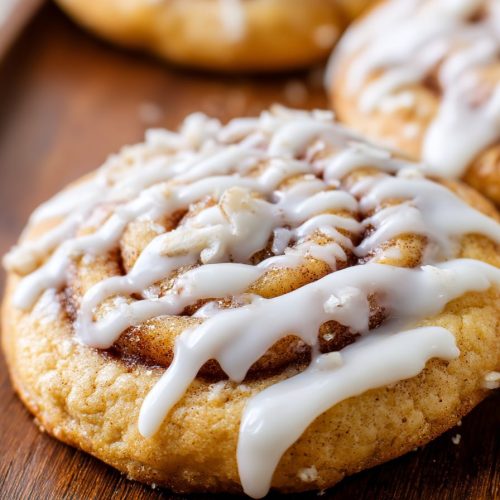
Cinnamon Roll Cookies
These Cinnamon Roll Cookies deliver all the cozy flavor of a classic cinnamon roll—soft sugar cookie dough, a rich cinnamon-sugar spiral, and a creamy cream cheese glaze—without any yeast or rising time.
Ingredients
- 2 3/4 cups all-purpose flour about 330 g; spooned and leveled
- 1 teaspoon baking powder
- 1/2 teaspoon fine sea salt
- 1 cup unsalted butter 2 sticks / 226 g, softened to room temperature
- 1 cup granulated sugar about 200 g
- 1 large egg at room temperature
- 2 teaspoons pure vanilla extract
- 2 tablespoons milk whole or 2%; dairy-free milk can be used
- 1/4 cup unsalted butter 1/2 stick / 56 g, very soft or melted, for filling
- 1/2 cup light brown sugar about 100 g, packed, for filling
- 2 tablespoons granulated sugar for filling
- 1 1/2 tablespoons ground cinnamon fresh, good-quality; for filling
- 1/4 teaspoon fine sea salt for filling
- 1/4 cup pecans or walnuts very finely chopped; optional add-in for filling
- 3 tablespoons raisins finely chopped; 2–3 tablespoons, optional add-in for filling
- 3 ounces cream cheese 85 g, softened; full-fat preferred, for glaze
- 2 tablespoons unsalted butter softened, for glaze
- 3/4 cup powdered sugar 90–120 g, sifted; start with 3/4 cup and add more for thicker glaze
- 1/2 teaspoon pure vanilla extract for glaze
- 1 tablespoon milk or half-and-half 1–2 tablespoons, to thin glaze to drizzling consistency
- pinch of salt for glaze
Instructions
- In a medium bowl, whisk together the all-purpose flour, baking powder, and 1/2 teaspoon fine sea salt. Set aside.2 3/4 cups all-purpose flour, 1 teaspoon baking powder, 1/2 teaspoon fine sea salt
- In a large mixing bowl or stand mixer fitted with the paddle attachment, beat 1 cup softened unsalted butter and 1 cup granulated sugar on medium speed for 2–3 minutes, until pale and fluffy.1 cup unsalted butter, 1 cup granulated sugar
- Beat in the egg and 2 teaspoons vanilla until fully combined, scraping down the bowl as needed. Add the 2 tablespoons milk and mix again; the mixture may look slightly curdled, which is fine.1 large egg, 2 teaspoons pure vanilla extract, 2 tablespoons milk
- Add the dry ingredient mixture in two additions, mixing on low speed just until no streaks of flour remain. If the dough feels very sticky, sprinkle in 1–2 extra tablespoons flour. The dough should be soft but not wet.2 3/4 cups all-purpose flour
- Turn the dough out onto a lightly floured sheet of parchment paper and shape it into a rough rectangle about 1 inch thick. Wrap in parchment or plastic wrap and chill in the refrigerator for 30–45 minutes.
- While the dough chills, stir together 1/4 cup very soft or melted unsalted butter, 1/2 cup packed light brown sugar, 2 tablespoons granulated sugar, 1 1/2 tablespoons ground cinnamon, and 1/4 teaspoon fine sea salt until you have a thick, spreadable paste. If using, mix in finely chopped pecans or walnuts and/or chopped raisins so they’re evenly distributed.1/4 cup unsalted butter, 1/2 cup light brown sugar, 2 tablespoons granulated sugar, 1 1/2 tablespoons ground cinnamon, 1/4 teaspoon fine sea salt, 1/4 cup pecans or walnuts, 3 tablespoons raisins
- On a lightly floured sheet of parchment, roll the chilled dough into a rectangle about 12 x 9 inches and 1/4 inch thick. Keep the edges as straight as you reasonably can, pressing any cracks back together with your fingers.
- Gently spread the cinnamon sugar filling over the rolled dough, leaving about a 1/2-inch clean border along one long edge to help seal the log. Use an offset spatula or the back of a spoon to create an even layer.
- Starting from the long edge opposite the clean border, roll the dough up into a tight log, using the parchment to help lift and roll. If cracks form, pause to gently press them back together. When you reach the clean edge, pinch the seam to seal so the filling stays in place.
- Wrap the dough log tightly in parchment or plastic wrap and refrigerate for at least 1–2 hours, or up to overnight, until very firm. This ensures neat slices and defined swirls.
- When ready to bake, preheat the oven to 350°F (175°C). Line two baking sheets with parchment paper or silicone baking mats.
- Using a sharp serrated knife, slice the chilled log into 1/4- to 1/3-inch-thick rounds, using a gentle sawing motion with minimal downward pressure. If any slices become misshapen, nudge them back into rounds with your fingers. Arrange on the prepared baking sheets, leaving about 2 inches between cookies.
- Bake one sheet at a time for 10–12 minutes, or until the cookies look set around the edges but are still pale on top. The bottoms should be just lightly golden. Let cool on the baking sheet for 5 minutes, then transfer to a wire rack to cool completely.
- In a small bowl, beat together the softened cream cheese and 2 tablespoons softened unsalted butter until smooth. Add 3/4 cup sifted powdered sugar, 1/2 teaspoon vanilla, a pinch of salt, and 1 tablespoon milk or half-and-half. Stir until smooth and glossy, adding more milk a teaspoon at a time to reach a drizzling consistency or more powdered sugar for a thicker glaze.3 ounces cream cheese, 2 tablespoons unsalted butter, 3/4 cup powdered sugar, 1/2 teaspoon pure vanilla extract, 1 tablespoon milk or half-and-half, pinch of salt
- Once the cookies are completely cool, drizzle or spread the cream cheese glaze over the tops using a spoon, offset spatula, or piping bag. Let the glaze set for 15–20 minutes before stacking or storing.
Notes
Yield: about 24–30 cookies, depending on how thick you slice them. Chill time is crucial for clean spirals and to prevent excessive spreading. For make-ahead, you can chill the dough log overnight or freeze it for up to 2 months (wrapped tightly in plastic and foil), then thaw in the fridge before slicing and baking. Baked, glazed cookies keep 2 days at room temperature or up to 5 days in the fridge; unglazed cookies can be frozen up to 2 months and glazed after thawing.
Nutrition
Calories: 180kcal
Love this recipe?Follow us at @Recipecs for more