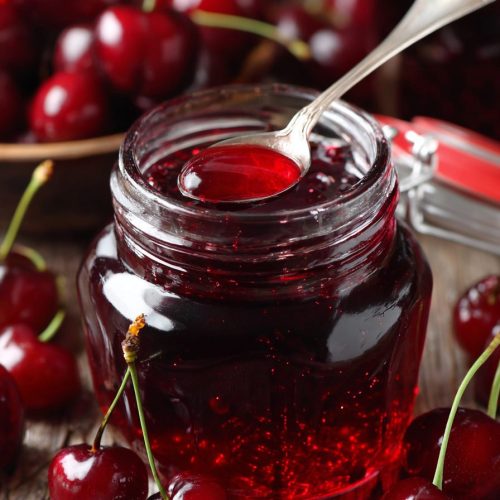
Cherry Jelly Recipe
A bright, sweet-tart, old-fashioned cherry jelly made from real cherries and simple ingredients, with options for classic pectin-set or no-pectin versions and full water-bath canning directions.
Ingredients
- 3 pounds fresh cherries sweet, tart, or a mix; washed, stemmed, and pitted (for pectin version; yields about 4 cups juice)
- 1-1 1/2 cups water just enough to barely cover cherries when cooking to make juice
- 4 cups cherry juice from cooked cherries above or 100% unsweetened bottled cherry juice (pectin version)
- 4 cups granulated sugar classic ratio for a good set and bright flavor
- 2 tablespoons bottled lemon juice for acidity and better set; use bottled for consistent acidity
- 1 box (1.75 oz) powdered fruit pectin classic powdered pectin such as Sure-Jell (yellow box) or Ball Classic Pectin
- 4 pounds fresh cherries for no-pectin version; washed, stemmed, and pitted (yields about 5 cups juice)
- 5 cups cherry juice from cooked cherries (no-pectin version)
- 4-5 cups granulated sugar start with 4 cups, add up to 1 cup more to taste (no-pectin version)
- 3 tablespoons bottled lemon juice no-pectin version
- 1/2 teaspoon unsalted butter optional; helps reduce foaming while boiling jelly
- Vanilla bean optional; 1 split bean for cherry vanilla jelly variation
- 1 teaspoon lime zest optional; plus swap half the lemon juice for lime juice for cherry lime variation
- 1 cinnamon stick optional; for spiced cherry jelly
- 2-3 whole cloves optional; for spiced cherry jelly
- 1/2-1 cup very finely chopped cherries optional; stirred in at the end for jam-style spread
- 2-3 tablespoons kirsch or cherry liqueur optional; for adult dessert cherry jelly (do not can this version)
Instructions
- Rinse cherries well in cool water, remove stems, and pit them using a cherry pitter or a small paring knife. Discard any moldy or badly shriveled cherries. Slightly soft fruit is fine.3 pounds fresh cherries, 4 pounds fresh cherries
- Add the pitted cherries to a large, heavy-bottomed pot. Pour in just enough water to barely cover the fruit (about 1–1 1/2 cups per 3 pounds). Bring to a gentle boil, then reduce to a simmer and cook for 15–20 minutes, stirring occasionally, until the cherries are very soft and releasing lots of juice.3 pounds fresh cherries, 1-1 1/2 cups water, 4 pounds fresh cherries
- Lightly mash the softened cherries with a potato masher or the back of a spoon to release more juice. Pour the mixture through a fine-mesh strainer lined with cheesecloth, a jelly bag, or a clean flour sack towel into a large bowl or measuring pitcher. For the clearest jelly, let it drip on its own for 2–3 hours or overnight in the fridge without squeezing. For a higher yield and slightly cloudier jelly, gently press the solids. Measure the strained juice: you need 4 cups for the pectin version or 5 cups for the no-pectin version. If short, top up with unsweetened cherry juice or water.4 cups cherry juice, 5 cups cherry juice
- Wash jars, lids, and bands in hot, soapy water and rinse well. Use half-pint or pint jars for jelly. Place the clean jars in a canner or large pot of simmering water to keep them hot while you cook the jelly. Set up a canning station with a jar funnel, ladle, clean damp cloth, and jar lifter.
- For the pectin version, pour 4 cups of cherry juice into a large pot. Whisk in the powdered fruit pectin until fully dissolved, breaking up any lumps. Over high heat, bring the mixture to a full rolling boil that doesn’t stop when stirred. If desired, add a 1/2 teaspoon pat of butter to help reduce foam. Stir in 4 cups granulated sugar and 2 tablespoons bottled lemon juice all at once. Stir constantly until the sugar is fully dissolved, then return to a full rolling boil. Boil hard for 1 minute, stirring the entire time so it doesn’t scorch or boil over.4 cups cherry juice, 4 cups granulated sugar, 2 tablespoons bottled lemon juice, 1 box (1.75 oz) powdered fruit pectin, 1/2 teaspoon unsalted butter
- Remove the pot from the heat and skim off any foam from the surface if you prefer a clearer jelly. To test the set, spoon a little hot jelly onto a chilled plate and let it sit for about a minute. Gently push the edge with your fingertip; if it wrinkles slightly and doesn’t run like syrup, the jelly has reached a good gel. If it is still too thin, return the pot to the heat and boil for another 30–60 seconds, then test again.
- For the no-pectin version, add 5 cups cherry juice, 4–5 cups granulated sugar, and 3 tablespoons bottled lemon juice to a large pot. Stir to dissolve the sugar. Bring to a boil over medium-high heat, then lower the heat slightly and maintain a steady boil, stirring often, for 25–40 minutes, until the mixture thickens slightly and darkens a bit. Use the chilled plate test to check for gel or watch for the jelly to begin sheeting off the spoon: it should drip more slowly and form a sheet instead of quick, separate drops.5 cups cherry juice, 4-5 cups granulated sugar, 3 tablespoons bottled lemon juice
- For cherry vanilla jelly, add a split vanilla bean to the cherry juice while heating, then remove it before adding sugar and pectin. For cherry lime jelly, replace half of the bottled lemon juice with lime juice and add 1 teaspoon finely grated lime zest. For spiced cherry jelly, add a cinnamon stick and 2–3 whole cloves while simmering the juice, then strain well before measuring and proceeding. For a jam-style spread, stir in 1/2–1 cup very finely chopped cherries at the end of cooking, just before filling the jars. For an adult dessert version, stir in 2–3 tablespoons kirsch or cherry liqueur after removing the jelly from heat; do not can this version—refrigerate or freeze instead.Vanilla bean, 1 teaspoon lime zest, 1 cinnamon stick, 2-3 whole cloves, 1/2-1 cup very finely chopped cherries, 2-3 tablespoons kirsch or cherry liqueur
- Working quickly while the jelly is hot and the jars are hot, remove a jar from the simmering water and drain it. Ladle hot jelly into the jar using a funnel, leaving 1/4-inch headspace at the top. Run a clean butter knife or nonmetallic spatula around the inside edge of the jar to release air bubbles. Wipe the rim with a clean, damp cloth to remove any spills. Place a lid on the jar and screw on the band until fingertip-tight. Repeat with remaining jars and jelly.
- Place the filled jars in a water-bath canner or large pot with a rack, ensuring the jars are covered by at least 1–2 inches of water. Bring to a gentle, steady boil and process for 10 minutes (adjust processing time if needed for your altitude per standard canning guidelines). When the time is up, turn off the heat, remove the lid, and let the jars rest in the hot water for about 5 minutes.
- Use a jar lifter to carefully transfer the jars to a towel-lined counter, keeping them upright. Let them cool undisturbed for 12–24 hours. Once cooled, check the seals: the lids should be slightly concave and should not flex up and down when pressed in the center. Any unsealed jars should be refrigerated and used first within 3–4 weeks.
- Label sealed jars with the contents and date. Store in a cool, dark pantry for 12–18 months. Once opened, refrigerate and use within 3–4 weeks. For a freezer version (no canning), ladle hot jelly into clean jars or freezer containers, leaving about 1/2 inch headspace, cool completely, then freeze for up to 6 months. Thaw overnight in the refrigerator before using. Serve on toast, biscuits, yogurt, PB&J sandwiches, desserts, cheese boards, or use warmed as a glaze for baked goods.
Notes
Cherries: You can use sweet, tart, or a mix of cherries; tart cherries give a brighter, tangier jelly, while sweet cherries make a richer, dessert-like spread. Frozen cherries work well—thaw them first and proceed as with fresh. Sugar: Classic powdered pectin requires the full sugar amount for a reliable set; for lower-sugar jelly, use a low- or no-sugar pectin and follow the package directions. Set issues: If your jelly seems too soft, let the jars sit 24–48 hours—many batches firm up as they rest. Softer jelly is excellent as a sauce for pancakes, yogurt, and desserts. If it is still too soft and you want a firmer set, you can reheat the jelly with a bit more pectin, bring it back to a full rolling boil for 1 minute, then re-jar and reprocess. If the jelly is too firm, gently warm a jar in a bowl of warm water or in a small saucepan with 1–2 teaspoons water, stirring until loosened. Foam control: A small pat of butter added at the beginning of boiling helps control foam. Color: Tart cherries typically produce a brighter red jelly, while sweet cherries can look deeper and more garnet-colored. Gifting: Jelly makes an excellent homemade gift—tie on a tag with the flavor and date, and consider pairing it with homemade bread or cookies.
Nutrition
Calories: 50kcal
Love this recipe?Follow us at @Recipecs for more